With the growing global focus on green energy and sustainable development, lighting demands for urban roads, residential areas, industrial parks, and scenic spots are constantly evolving. Against this backdrop, integrated solar street lights have emerged as the preferred lighting solution for both corporate and government projects. Compared to traditional streetlights, these products not only reduce electricity bills and maintenance costs but also effectively lower carbon emissions, aligning with modern urban sustainability requirements. For users, selecting a reliable solar street light manufacturer is crucial for ensuring project success.
This article provides a detailed analysis of integrated solar street lights, covering their fundamental concepts, operating principles, advantages, application scenarios, and procurement guidelines. It aims to empower designers and builders to make informed decisions when selecting and implementing lighting projects.
The integrated solar street light is a lighting device that integrates solar panels, LED lights, batteries, controllers and the lamp pole into one unit. Compared with traditional solar street lights, the integrated design reduces the complexity of circuit connections and installation, making the equipment more compact, durable and easier to maintain.
• Solar Panel
The solar panel is the core energy device of the street lamp. It converts light energy into electrical energy. High-efficiency polycrystalline or monocrystalline solar panels can ensure sufficient power under limited sunlight conditions, providing stable energy for the LED light source. For the purchaser, choosing a reliable solar panel not only ensures the stability of street lamp lighting but also extends the overall lifespan.
• LED Light Module
The LED light module directly reflects the lighting effect. Integrated solar street lamps usually use high-brightness LED chips, which can provide uniform and bright lighting at night. Moreover, the LED light source has low energy consumption. Combined with solar power supply, it can achieve truly energy-saving lighting.
• Battery & Controller
The battery is responsible for storing the electricity generated during the day for use at night. High-quality lithium batteries have long lifespan and deep cycle capabilities. The controller manages the charging and discharging process and can achieve intelligent dimming, timed switching, light control, and remote monitoring functions. This means that the street lamps can operate flexibly in different application scenarios while reducing maintenance costs.
• Light pole and installation structure
The integrated design typically includes corrosion-resistant light poles and installation structures, which can adapt to various road and environmental conditions. The overall design is simple, reducing installation time and lowering the requirements for the technical skills of construction workers.
In summary, the integrated solar street light achieves this by integrating all components for coordinated operation. This not only ensures the lighting effect but also enhances the product's reliability and the feasibility of the project.
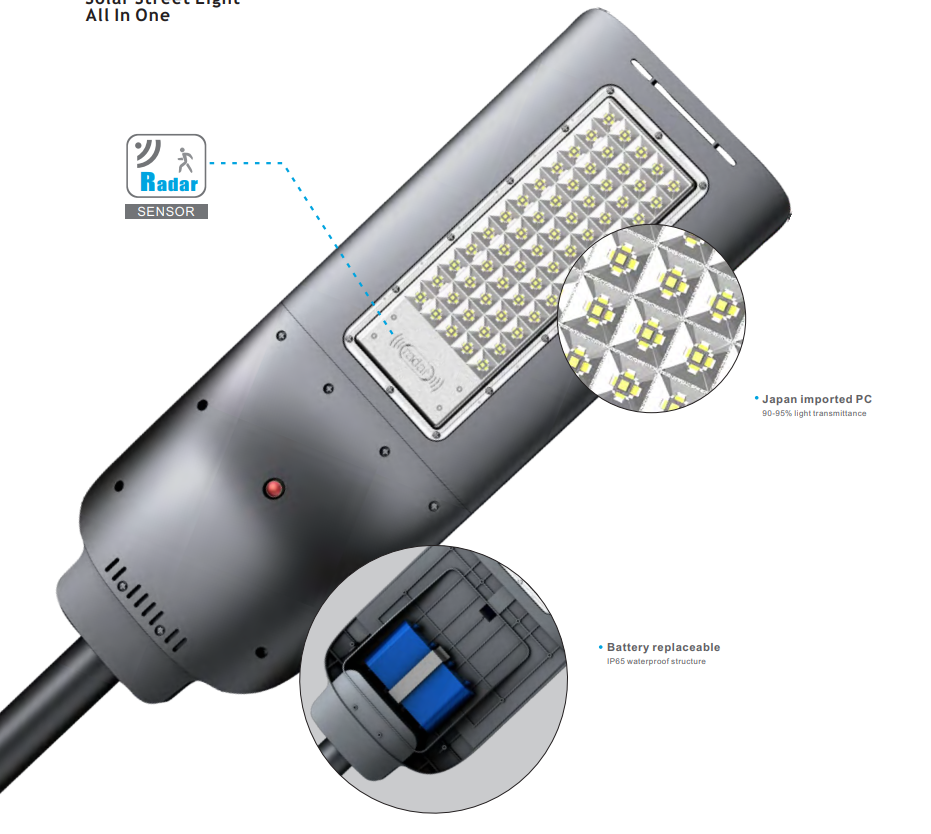
The integrated solar street light collects solar energy through solar panels, stores it in the built-in battery, and provides lighting at night through LED lights. Its core advantages lie in the integrated design and intelligent control, which make the entire system stable and efficient, and adaptable to different climates and lighting requirements.
1. Daytime charging stage: Solar energy absorption and storage
During the day, the integrated solar street light relies on efficient solar panels to convert light energy into electrical energy. The types of solar panels usually include polycrystalline or monocrystalline, with the monocrystalline panels being more efficient and capable of generating more electricity in a shorter period of sunlight. The controller is responsible for monitoring the charging process, ensuring that the battery is charged within the safe voltage range and preventing overcharging or overdischarging.
The built-in battery is usually a lithium battery, which has high energy density and long cycle life, and can store sufficient power to ensure continuous lighting at night. High-quality batteries and intelligent controllers mean that even in cloudy or continuous rainy conditions, the street lamps can operate stably.
In addition, modern China integrated solar street lights are usually equipped with Maximum Power Point Tracking (MPPT) technology, which can intelligently adjust the charging current according to the light intensity, thereby improving the battery charging efficiency. As a result, each street lamp purchased by the builders can achieve the best energy efficiency in different environments, reducing long-term maintenance costs.
2. Night lighting stage: Output of LED light source
When the light intensity is lower than the set value, the controller automatically activates the LED light source to provide road or area lighting. The power of the LED module in the integrated solar street light is matched with the height of the lamp pole, the width of the road and the lighting standard, ensuring uniform illumination and sufficient brightness.
LED light sources have the characteristics of high luminous efficiency, low energy consumption and long lifespan. Combined with stored electrical energy, street lamps can operate continuously for several hours, meeting the needs of night lighting. The intelligent controller can also automatically adjust the brightness according to the battery power and lighting requirements, achieving energy-saving mode. For example, it can reduce the brightness during off-peak traffic hours to extend the battery usage time.
3. Intelligent Management and Remote Monitoring
Modern integrated street lamps are usually equipped with intelligent control systems, which can provide functions such as remote monitoring, fault alarm and data analysis. Users can view the operating status, power level, lighting duration and energy consumption data of each street lamp through the cloud management platform.
The benefits brought by intelligent management include:
Identify problems promptly: For instance, if there is an abnormality with the battery, an LED failure, or a controller malfunction, a remote alarm can be triggered, thereby reducing the cost of manual inspections.
Optimize energy consumption: Through data analysis, lighting strategies can be adjusted reasonably to achieve maximum energy savings.
Project scalability: For large-scale road, industrial park or scenic area projects, it is possible to centrally manage hundreds or even thousands of street lights, thereby improving operation and maintenance efficiency.
Through intelligent management, enterprises can not only save on labor and energy costs, but also enhance the reliability of projects. This is also an important consideration when choosing a high-quality solar street light manufacturer supplier.
The integrated solar street light boasts significant advantages in terms of energy conservation, environmental protection, ease of installation, and long-term reliability through its integrated design and intelligent control.
For large-scale road projects, industrial parks or scenic area projects, the high efficiency and energy-saving features of China Integrated Solar Street Lights can yield significant investment returns (ROI) over a period of several years.
Reduce construction costs: Due to the integrated design that combines solar panels, batteries, controllers and LED lights in a single module, during the installation process, there is no need to lay complex cables or additional power lines, thereby reducing construction labor and material costs.
Reduce electricity costs: The street lamps charge themselves using solar panels during the day, eliminating the need for power supply from the main grid. This enables enterprises to significantly reduce their lighting electricity expenses.
Long-term operation cost savings: LED light sources have a long lifespan and low maintenance frequency. Combined with durable batteries and controllers, they can reduce maintenance costs and replacement frequencies throughout the entire lifecycle.
The integrated design makes installation and maintenance simple and efficient, reducing the reliance on professional technicians.
Installation is fast: Traditional street lamps usually require separate wiring, cable laying and installation of multiple components, while the integrated solar street light integrates all core components, significantly shortening the construction period.
Maintenance is easy: The battery, circuit and LED module are integrated in the same module. When a fault occurs, only the single component needs to be maintained, without the need to dismantle the entire street lamp.
Adaptable to various environments: The integrated design is compact, with a high level of waterproof and dustproof capabilities (typically IP65 or above), allowing for long-term use in areas with heavy rainfall, abundant dust, or strong sandstorms.
Environmental characteristics are an important consideration in modern project decisions.
Zero carbon emissions: The streetlights are powered by solar energy, eliminating the need for grid electricity or fossil fuels, thereby reducing greenhouse gas emissions.
Energy efficiency: LED light sources have high luminous efficiency and low power consumption. When combined with solar cells, they achieve true energy conservation.
Reliability is a key factor determining whether large-scale projects can be successfully implemented.
High-quality components: Utilizing high-quality solar panels, batteries and LED lights, ensuring that the street lamps can operate stably under various climatic conditions.
Resistant to extreme weather: The integrated design ensures that the equipment is resistant to wind, rain and corrosion, and can be used for a long time in coastal, cold or hot environments.
Longevity: The lifespan of LED light sources can exceed 50,000 hours, and the battery has a long cycle life, reducing the frequency of replacements.
Intelligent management not only enhances operational and maintenance efficiency but also provides data support for the company, which can be used to optimize future project planning.
Remote Monitoring: Users can view the status, power level, and fault conditions of each street lamp in real time through the platform.
Energy-saving Dimming Mode: The brightness can be automatically adjusted according to traffic flow, time period, or light intensity to achieve the optimization of energy consumption.
Fault alarm and warning: When there is any abnormality with the LED or the battery, the system will automatically send out a warning, thereby reducing the inspection costs.
6. Flexible Customization Capability
By choosing a reliable solar street light manufacturer or an integrated solar street light supplier, you can obtain a customized solution that fully meets the project requirements, ensuring the maximization of investment value.
Power Selection: Different power LED modules can be selected based on road width and lighting requirements.
Light Pole Height and Design: Customizable light pole heights and designs suitable for urban streets, industrial parks, or scenic areas.
Control Modes: Supports light control, time control, remote control, and intelligent dimming to meet the functional requirements of different projects.
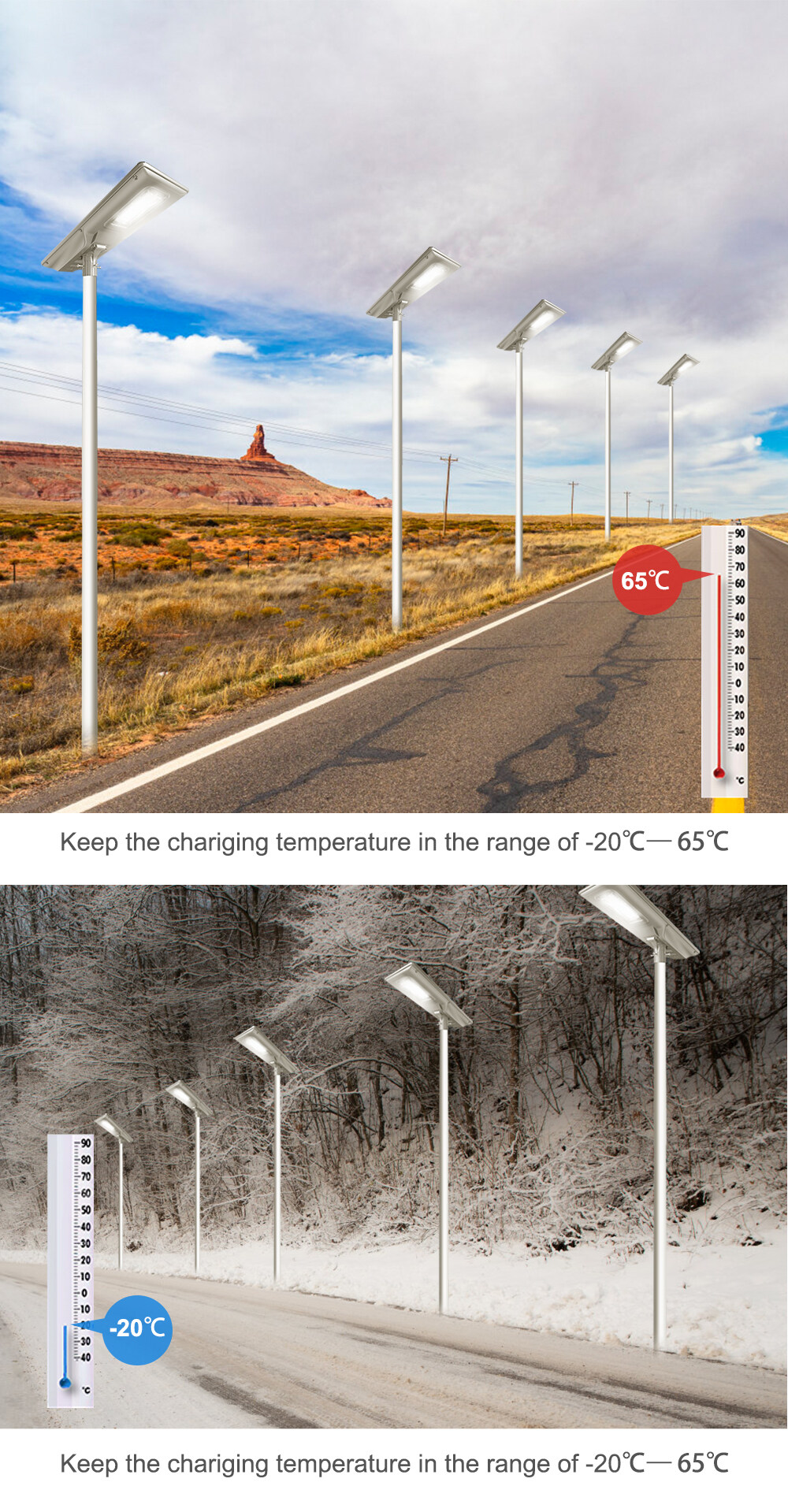
china integrated solar street light
Due to its features such as energy conservation, independent power supply, flexible installation and low maintenance cost, the integrated solar street light has been widely applied in various commercial and public infrastructure projects. Currently, integrated solar street lights are mainly used in various scenarios such as urban roads, industrial parks, residential communities, public spaces and remote areas.
• Urban roads and highways: Provide uniform and bright lighting, reduce night-time traffic accidents, and enhance road safety.
• Industrial parks and factories: Save lighting costs while meeting the lighting demands of large-scale parks.
• Residential areas and communities: Improve the nighttime lighting environment to enhance residents' sense of security and quality of life.
• Parks and scenic areas: Integrated with landscape design, they are both environmentally friendly and aesthetically pleasing, reducing the impact of construction on the natural environment.
Choosing the appropriate integrated solar street light is not merely a matter of comparing prices or appearances. Instead, it requires a comprehensive assessment from multiple aspects such as lighting requirements, energy configuration, structural design, and operational stability.
Lighting performance is the most fundamental and crucial factor when choosing an integrated solar street light.
Different road grades and application scenarios have specific requirements for illumination, brightness uniformity, and coverage range. If the optical design of the lamp is unreasonable, even if the power is high, it may still not meet the actual lighting needs. When selecting the model, the following points should be given special attention:
Whether the light efficiency of the LED source can provide sufficient brightness under low power consumption.
Whether the light distribution design is reasonable and can cover the effective width of the road or area.
Whether the light is uniform and whether dark areas or glare occur.
2. Solar Panel Configuration and Power Generation Efficiency
When selecting integrated solar street lights, the type and area of solar panels must be matched to the sunlight conditions at the project site.
Key considerations include:
The conversion efficiency of solar panels, ensuring they can complete charging within limited daylight hours.
The impact of material type (e.g., monocrystalline or polycrystalline) on power generation efficiency.
Whether the angle design between the panel and lamp body maximizes solar absorption.
In regions with weaker sunlight conditions, rational solar panel configuration is particularly crucial. This represents a key optimization focus in the design of many China integrated solar street lights.
3. Battery Capacity and Battery Life
The battery system determines the working capability of the street lamps during the night and in continuous rainy weather. When selecting the type, the following aspects should be considered:
Whether the battery capacity matches the LED power and the duration of lighting.
Whether the battery type is suitable for high-frequency charging and discharging applications.
Whether it can support normal operation in multiple days of continuous rainy weather.
3. Intelligent Control and Energy Consumption Management Capabilities
Modern integrated solar street lamps are increasingly emphasizing intelligence, and the control system plays a core role in this. Intelligent control not only affects user experience but also directly relates to energy utilization efficiency. When making a choice, the following aspects should be given priority consideration:
Whether it supports light control, time control, or automatic dimming modes.
Whether it can dynamically adjust brightness based on battery power.
Whether the control logic is stable to avoid frequent start-stop or energy waste.
4. Structural Design and Protective Performance
Although the integrated design simplifies the installation process, it imposes higher requirements on the structural strength and protective performance. The lamps need to be exposed to outdoor environments for a long time, enduring wind, rain, dust, and temperature variations. When selecting the product, attention should be paid to:
Whether the overall structure is stable and suitable for long-term outdoor use.
Whether the waterproof and dustproof grades meet the requirements of the project environment.
Whether the shell material has corrosion resistance and anti-aging properties.
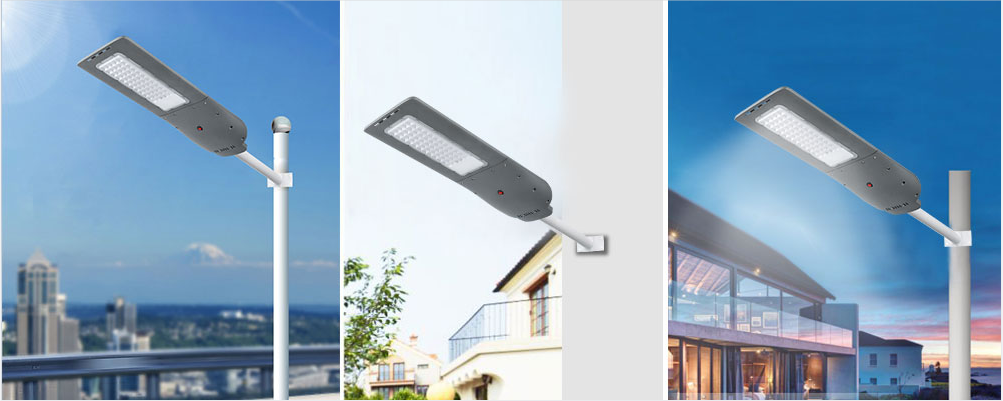
Selecting the appropriate solar street light manufacturer is the key to ensuring the success of the project.
Production capacity and certification: Ensure that the manufacturer has relevant production qualifications, ISO certification, and product test reports.
Product quality and reliability: Evaluate through sample testing, reference cases, and customer feedback.
Customization and technical capabilities: Be able to provide customized solutions that meet project requirements, including different power ratings, control modes, and lamp post designs.
Price and delivery cycle: Reasonable pricing and timely delivery are important guarantees for project management.
Service and support: Include installation training, after-sales maintenance, remote monitoring, and technical consultation. Selecting an outstanding supplier of China integrated solar street lights can help enterprises reduce risks, enhance project efficiency and sustainability.
The integrated solar street light, with its energy-saving and environmentally friendly features, ease of installation, intelligent management, and long-term reliability, has become the ideal choice for modern lighting projects.
As a professional integrated solar street light supplier, Yuefeng has advanced production facilities and rich industry experience in China and is capable of providing customers with high-quality customized solutions. Whether it is for urban roads, industrial parks, or scenic area lighting projects, choosing Yuefeng not only ensures reliable products but also offers comprehensive technical support and excellent services, ensuring the smooth completion of the project from design to delivery.